Sunday, 9 October 2011

Mystery House Reboot


MYSTERY HOUSE REBOOT

Part 1 : Research & Ideas


http://www.screwattack.com/blogs/The-MisterBo-Corner/g1-Tournament-Bracket-Battle-5-GeekyGuyWithGlasses-vs-Madhero15-and-Battle-4-Results

http://www.gamesradar.com/the-evolution-of-scary-games/

http://www.mobygames.com/game/hi-res-adventure-1-mystery-house/cover-art/gameCoverId,39881/


from wiki:
"Mystery House is an adventure computer game released in 1980 by Roberta and Ken Williams for the Apple II. The game is remembered as one of the first adventure games to feature computer graphics and the first game produced by On-Line Systems, the company which would evolve into Sierra On-Line. Because of its use of graphics, GamePro named Mystery House the 51st most important game of all time in 2007."
Plot:
"The game starts near an abandoned Victorian mansion. The player is soon locked inside the house with no other option than to explore. The mansion contains many interesting rooms and seven other people: Tom, a plumber; Sam, a mechanic; Sally, a seamstress; Dr. Green, a surgeon; Joe, a gravedigger; Bill, a butcher; and Daisy, a cook.
Initially, the player has to search the house in order to find a hidden cache of jewels. However, terrible events start happening and dead bodies (of the other people) begin appearing. It becomes obvious that there is a murderer on the loose in the house, and the player must discover who it is or become the next victim."
http://en.wikipedia.org/wiki/Mystery_House

In game story/ background research:
As explain on the plot section above, Mystery House is a thriller text-based adventure game that requires player to explore around finding items that in one way or another will 'unlock' the progress of the game, so in a way, it is very puzzle based; encounter problem> find answer >solve problem> move on kind of game-play. This has been the core of so many well known exploration-inclined games such as; Wild Arms series, Resident Evil series, Portal series and ICO just to name a few.
The narrative itself was inspired by a book by Agatha Christie called "Ten Little Niggers" which was then rephrased to "And then there were none" due to presence of the racial epithet.
http://en.wikipedia.org/wiki/And_Then_There_Were_None

This book tells a tale of 10 strangers brought to an island by an unknown host and killed of one by one just like in the game. However, the twist was that each murder committed is parallel to the nursery poem, 'Ten Little Indians/ Soldies' down to the last bit where the last person alive in the story hanged herself; "One little Indian boy left all alone; He went out and hanged himself and then there were none." Also a piece from a ten soldier boy figurines in the dining room table went missing each time the murder occurred. This might be something I'd like to carry over to my reboot as well.


Ten Little Indians poem


Ten little Indian boys went out to dine;

One choked his little self and then there were nine.

Nine little Indian boys sat up very late; 

One overslept himself and then there were eight. 

Eight little Indian boys traveling in Devon;

One said he?d stay there and then there were seven. 

Seven little Indian boys chopping up sticks;

One chopped himself in halves and then there were six.

Six little Indian boys playing with a hive; 

A bumblebee stung one and then there were five. 

Five little Indian boys going in for law, 

One got in Chancery and then there were four.

Four little Indian boys going out to sea; 

A red herring swallowed one and then there were three. 

Three little Indian boys walking in the Zoo; 

A big bear hugged one and then there were two.

Two little Indian boys sitting in the sun; 

On got frizzled up and then there was one. 

One little Indian boy left all alone; 

He went and hanged himself and then there were none.

Its an interesting tale full of dark twist and having read the book prior to this project definitely will help a lot in capturing the essence of the novel that was portrayed in Mystery House.
In addition, Mystery house put a spin on the narrative slightly by adding the 'Jewels' as a motive and the player as the last character to survive by killing 'Daisy' the antagonist of the game during a climatic kill or be killed situation.


Gameplay research:
Mystery House was heavily influenced by another similar text-based games like Zork/ Colossal Cave (minus the visual), which at the time was a success in gaming industry. I believe this visual text-based genre evolved to be other different types of game-play such as; adventure, thriller, mystery, puzzle, trivia based exploration games, even dating-sims and it is most probably how Point & Click and Escape games came about.
Few examples of games that comes to mind that's I can relate to rebooting Mystery House:

1) The Witch's Prison (Ipad/ Iphone)

app store
http://itunes.apple.com/us/app/nightmare-adventures-the-witchs/id445383816?mt=8


http://www.youtube.com/watch?v=zKt1-tMGQao


http://www.mobygames.com/game/ipad/nightmare-adventures-the-witchs-prison/screenshots/gameShotId,524849/


http://www.mobygames.com/game/ipad/nightmare-adventures-the-witchs-prison/screenshots/gameShotId,524852/


http://www.mobygames.com/game/macintosh/nightmare-adventures-the-witchs-prison/screenshots/gameShotId,524905/

2) Blade Runner game

http://www.youtube.com/watch?v=acBnLMRIAD0

wiki
http://en.wikipedia.org/wiki/Blade_Runner_(1997_video_game)


http://uk.gamespot.com/pc/adventure/bladerunner/images/0/5/?tag=thumbs_below%3Bthumb;5

3) Myst series


http://www.youtube.com/watch?v=DNVLcHWh0UA&feature=related

http://en.wikipedia.org/wiki/Myst_(series)

http://en.wikipedia.org/wiki/File:Myst-library_and_ship.jpg&docid=GdBHZoPLU-2PkM&w=500&h=306&ei=cheSToKELoyf-QaP5aXGDA&zoom=1

http://en.wikipedia.org/wiki/Myst&docid=KIi1EYLYfOtiqM&w=256&h=307&ei=cheSToKELoyf-QaP5aXGDA&zoom=1

4) Drawn The Painted Tower


http://www.youtube.com/watch?v=Vp9dW3YxGfE


http://en.wikipedia.org/wiki/File:Drawn-the-painted-tower.png&docid=mej_wO_mv_83MM&w=600&h=855&ei=WRuSTvqdHYe6-Aao7ICGCw&zoom=1

http://www.harmonicflow.com/game/drawn-the-painted-tower/&docid=jrt49DSdBTDG4M&w=640&h=480&ei=WRuSTvqdHYe6-Aao7ICGCw&zoom=1


http://www.macgamesandmore.com/blog/drawn-the-painted-tower/&docid=r4DT7A6LeskJLM&w=620&h=467&ei=WRuSTvqdHYe6-Aao7ICGCw&zoom=1

The 4 examples mentioned above are all very narrative (not necessarily have an awesome/ massive plot/ twist) driven games with minimalistic game-play style; they all have very simple HUD or even none, which I strongly believe can greatly affect the player’s immersion in the experience.

MYST intentionally left out tutorials or hints which the other 3 games uses, this I think is also brilliant in keeping the experience real as well and allows players to think and get more satisfaction out of solving puzzles without any clue, this might be bad in some cases as it may confuse and left player lingering in one spot for ages, however as done in games such as Another World, Demon Souls, Portal, Shadow of Colossus; managed tutorials/ hints as a part of story and not necessarily have to be a separate section which detach players from the game.

One last important observation would be that all of them are using so called ‘Page by page’ environment where player is unable to freely explore a 3D area like in games such as Grand Theft Auto/ Fallout type of sandbox exploration, instead we have fixed angles that player can explore inside of. It is more commonly used in third-person Horror/ Action/ RPG and point & click genre games. Many games actually started out this way and later on evolved to a fully 3D exploration game like; Silent Hill series, Resident Evil series, Final Fantasy series and even MYST. I’d like to keep Mystery House ‘Page by page’ as this method is very cinematic and I’d like to shape this game to be slightly like a interactive thriller movie, more importantly it functions well for point and click games and also in my opinion, when MYST was remade into fully 3D control it lost lots of the mysterious essence it originally had. 


Sales/ pitch research:

Essence taken from original Mystery House:
- Still sets in a house/ mansion
- Puzzle based/ solving gameplay
- Eerie atmosphere ( like how everybody just disappeared the 2nd time at lobby )
- Story influence goes back to 'And then there were none' Novel by Agatha Christie.
- The Jewels
- dull color except for key items? like in Mirrors Edge. (original game is B&W lines)

Changes in reboot:
- New plot & look (see New Plot & Concepts)
- Point/ touch & Click based thriller
- if its on touch-screen enabled gadgets, will be more actions involving swiping & other gestures

Target audience:
- 13 - 40 yrs ( mainly people who owns the gadgets mentioned in consoles targeted section,
and also old enough to see experience gore and morbid story.)
- also might appeal to people who played original Mystery House from the 80s


Consoles targeted:

Main:
- Ipad/ Iphone
- NDS/ 3DS
- PC

other possibilities:
- PS3's PSN
- Xbox Live Marketplace

No-no:
- Wii
- PSP
- Arcade


Part 2 : Developing the game

-    
-        New Plot & Concepts:


-       -Night time, raining heavily
-       -Main character, Henry, crossing a wooden bridge to a lush Gothic looking mansion (located on a cliff surrounded by ravines).
-       -Inside greeted by 7 other fellow guest.
-       -After being ushered to his room and took a nap, Henry was woken up by loud explosion.
-       -The bridge (only way back out to ‘outside world’) was destroyed and everybody gathered round to realize 1 person was missing and found dead later on.
-       -After a few more incidents, it became apparent that everybody died in a certain way involving their jobs & a murder is loose in the mansion.
-       -Everybody started turning on each other.
-       -Amidst the confusion, Henry uncovered a secret lab hidden under the mansion & met a prisoner called ‘Jewel’.
-       -Turns out one of the guests, Rose, faked her death in 1 of the incidents earlier & is the mastermind behind all the murder
-       -Henry & Jewel tried to escape
-       -Ended up in a climatic kill or be killed situation with Rose

Ending 1: Both Jewel & Rose died.
-       -In a climax of guilt, exhaustion and confusion, Henry walked towards the broken bridge and disappeared behind the fog.

Ending 2: Rose died.
-       -Found the secret path out to the bottom of Ravine and back up to the ‘Other-side’.

Ending 3: Henry died.
-       -Well, Henry died, Jewel got re-captured and the killing spree continues.


Sunday, 15 May 2011

Rigging Fundamentals


BA3
Rigging Fundamentals
Elbert Lim
1001740


In this project I am to construct a rig on Autodesk Maya that enables complex movement for inanimate digital assets. The rig that I will be creating would be for a bipedal asset with skins provided from the tutors like shown below.


Most importantly this rig have to be animator friendly and be able to be used for an in game asset and animation properly.

Process
The rig that I will be applying is called Reverse Foot Lock. It is a setup of external set of bones that drive the foot of character, its called a reverse foot lock because it is constructed going backward from the heel up the foot to the ankle.

This rigging process started by creating the bones or joints starting from the true beginning (hip> knee> ankles > ball> toe). I then proceed on making the IK handles and making sure the orientation and naming is properly assigned prior to that. After the handles are done, NURBs circles are created as controllers, which are then constrained to the handles on the ankles and the knees. Next, the waist joint is created as a center of gravity and when everything is movable the rig is then binded to the skin. Lastly the Reverse Foot lock is binded to the handles and the rig is good to go.

I made a loop of jumping animation using the bipedal rig and smooth the skin after animating it, below is what it looks like.


Finalizing
I rendered the clip on maya while at the same time making sure the skin are moving properly and not stretched (which can be resolved using the painting tools).  


Friday, 13 May 2011

Digital Modeling

Digital Modeling
In this project I am required to create a 3D model of a door by using Autodesk Maya 7 Autodesk Mudbox. At the end of this project, the 3D door will have to be a game-ready asset for rigging and production environment. This creation of 3D door involves digital modeling, UV mapping, digital sculpting and eventually rendering it out into an animation clip.

Cooking up the Design
I started my design by looking at different theme I can create for the doors, some that I find rather interesting are; medieval, gothic and surrealistic/ abstract style. After looking up references on the world wide web, I started my design and below is what I came up with in the end.


I intentionally avoided straight lines and proper shapes to try and give these designs a more artistic feel to it (which I slightly regret at crunch time). The 2nd design is very much influenced by Tim Burton style, slightly gothic, slightly crooked in structure and still retain a good simple composition, or at least that is what I was aiming for. I chose the 2nd design eventually, as it seems to be slightly more different than what a lot of people are going for.

Process
Below are screenshots of the modeling process done in Autodesk Maya


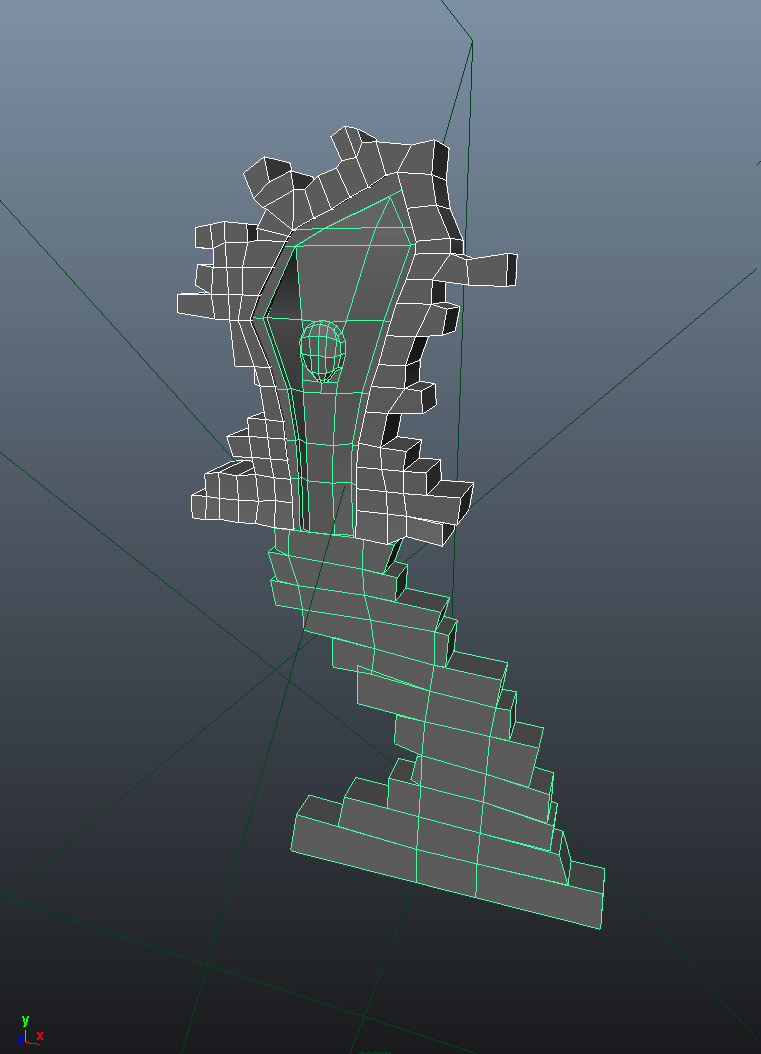
Started modeling the door and stairs from a single cube, following my sketch reference beginning with the frontal view and later on extruded the faces out from the side view.


Brick wall, lanterns and door handle follows soon after and the model is pretty much done.

Started UVing the model and realized that before I can take it to Mudbox, I have to fix the model so that it doesn’t have any extra vertex or faces that might hinder the process of subdivision level on Mudbox, this appears to be quite a challenge as at this point my model have lots of unwanted faces and parts that needed to be separated and fixed. I had so much trouble fixing this problem, I went back more than just a few times to fix the stairs and check back and forth between mudbox, I had to redo my stairs 3 times in the end to get it working on Mudbox properly.

After doing so, in Mudbox, parts by parts of the model is stenciled with my sketch and texture files, creating quite a nice texture on the 3D model, I have to say that this is the best part about the project in a long while to see the dead looking model suddenly came alive, although there isn’t any color yet, it is looking promising after all the setbacks I had.

Below are screenshots of the model after being sculpted on Mudbox.


 Lastly this I have to extract the normal map from this model to create a bump map on Maya. The idea is to make the model looks real and textured while in reality it is a flat surfaced polygons, this allows the model to be used in any games with no problem such as being too big in file size and lag. However during this process I realized there were more problems with my UVing and I had to redo it all over again on Maya before I do the bump mapping, again this takes more than a while and deadline is literally few days away at this point. Its very tempting to change the design and make it simpler, but I personally hate to compromise my own design for my technical incompetence, so I decided to kill a few more brain cells and stick with the concept. Unfortunately, the extraction on Mudbox kept failing and bump mapping is unable to be applied on the model, so I have to resolve leaving the model as a normal UV map on Maya.

Finalizing

I set a camera-aim to the model and animate it in a 180 degrees angle to show the necessary parts of the model, added an ambient light and made sure the rendering is in its highest setting. This model is then rendered to a .mov clip and below is the final look of my door design on Maya and when rendered out.


Sunday, 8 May 2011

Representation & Space

Definitions in games/media

Representation
“Representation refers to the construction in any medium (especially the mass media) of aspects of ‘reality’ such as people, places, objects, events, cultural identities and other abstract concepts. Such representations may be in speech or writing as well as still or moving pictures. “ (1)

Also with the knowledge that NUCA presentation slides provides me on Representation and Space, I believe that Representation in this context is more correctly explained as a form of portrayal, depiction or a concept, for example;

using blocks of simple polygons in a game to portray objects or even characters. For example in Squaresoft’s Final Fantasy 7 (1997) characters are in form of bad blockish 3D polygons, but players understand what this represents.


Also from number IX in the series, on the world map, towns/ cities/ dungeons are all depicted as big as the character, which is ridiculous, but obviously this is just a form of visual representation and players understand this concept without usually realizing this. This is also very common in Real Time Strategy (RTS) games or any game that possess large world map like areas.


Audio Representation
In retro games such as Rockman, Donkey Kong, Sonic the Hedgehog or Mario, representation of audio and visual are very important since both technologies were very limited during the time. Usually gunshots are depicted with a laser like sounds, damage by a snare-like punching sound usually accompanied by flashing of the subject and deaths usually are depicted with a short demoralizing catchy tune. Here is a spoof of retro games, although it is a parody, it still does points out these few things I mention of sound and visual representations in games.


Space
“An element of art, space refers to distances or areas around, between or within components of a piece. Space can be positive (white or light) or negative (black or dark), open or closed, shallow or deep and two-dimensional or three-dimensional. Sometimes space isn't actually within a piece, but the illusion of it is.” (2)

As explained above, Space refers to an area or sometimes the illusion of having an area, for example; a fully immersive 3D world map in a game, it is not real but if done right could make the player feels that the area exist and engaged in the game’s particular setting. A few good examples of games with immersive surroundings;


Red Dead Redemption (2010)
Set in the Wild West, environment plays a big part to grab players into this grim yet beautiful world of gun battles. Almost like it was taken straight from a John Wayne or Sergio Leone’s movies set, especially when this is a free roam sandbox game that requires players to explore and wander around a lot, it totally captured the essence of what being a gunslinger is like.


Shadow Of the Colossus (2005)
A fantasy story with a massive environment to roam around and get lost in (literally and mentally) in a good way; the landscape sometimes plays as a mini puzzle where players have to sort of find their way to certain colossus. Also very significant and plays a huge role during some of the Colossi battles, many times even utilizing the colossus themselves as environment.


Grand Theft Auto : San Andreas (2004)
Although the visual is pretty obsolete to today’s standard and contain lots of graphical glitches, it is still a fine game that utilizes its environment impressively, especially on missions involving air vehicles and trip to the country sides, which looks amazing and very lively for a game during the time.


More
Other games such as First Person Shooter Killzone 2 and 3, Stylish Action Devil May Cry series and Bionic Commando, have a similar way of presenting the illusion of space, by mapping out areas in the distance that aren’t actually accessible by players and blocked out by ‘invisible walls’ during the game. This gives the player the sense of freedom and being in a largely created environment, while the game itself is actually pretty much linear.


Technology
“The branch of knowledge that deals with the creation and use of technical means and their interrelation with life, society, and the environment, drawing upon such subjects as industrial arts, engineering, applied science, and pure science.” (3)

Some examples of today’s technology in games,


Motion Capture
A technology that allows capturing animation or facial expression from real reference by using ‘dots’ placed on the body or face, very often used in blockbuster movies and action packed games.

“Motion capture (AKA Mocap) used to be considered a fairly controversial tool for creating animation. In the early days, the effort required to 'clean up' motion capture data often took as long as if the animation was created by an animator, from scratch. Thanks to hard work by the manufacturers of motion capture systems as well as numerous software developers, motion capture has become a feasible tool for the generation of animation.” (4)


High Definition (HD) Visuals
Technology that allows smooth and crisp visual to be displayed.

“HDTV has one or two million pixels per frame, roughly five times that of SD.” (5)


Motion Sensors
Nintendo Wii, Xbox Kinect & Playstation Move are 3 examples of today’s top motion sensor technology.

“PlayStation Move is a motion-sensing game controller platform for the PlayStation 3 (PS3) video game console by Sony Computer Entertainment (SCE). Based on a handheld motion controller wand, PlayStation Move uses the PlayStation Eye camera to track the wand's position, and inertial sensors in the wand to detect its motion.” (6)


Creativity
“The ability to transcend traditional ideas, rules, patterns, relationships, or the like, and to create meaningful new ideas, forms, methods, interpretations, etc.; originality, progressiveness, or imagination: the need for creativity in modern industry; creativity in the performing arts.” (7)
Some examples of creativities in games;


Portal (2007)
It’s a simple concept of using a gun that fires 2 portals to solve puzzles throughout the whole game. Definitely a fresh new concept when it first came out.


Guitar Hero (2005)
Sure there were arcade version of instrumental game such as Guitar Freaks or Drums Revolution, but Guitar Hero did an amazing move by bringing them all in 1 game, gave the game a personality and even added a singing and up till now the types of instruments just kept on growing, not to mention the number of similar musically inclined games that followed up this concept.


Heavy Rain (2010)
An interactive drama, where u played scenes utilizing Quick Time Events (QTE) buttons and choices during the game. Story also branches out depending on how the player play out particular scenes, which in turns affects the ending as well. A very bold move by Quantic Dream, considering it’s a game that you basically watch 70 percent of the time, nevertheless it is definitely an intense and fresh experience for gamers who are looking for something different.


Culture
“A particular form or stage of civilization, as that of a certain nation or period: Greek culture.
Anthropology. The sum total of ways of living built up by a group of human beings and transmitted from one generation to another.” (8)

Examples of cultures in games;


Assassin’s Creed series (2007-2011)
Set in the ancient holy land during the year 1191.
Similarly Assassin’s Creed 2 is set in the northern Italy during the Renaissance (15th Century).


Suikoden series (1996-2008)
A Sony Japanese Role Playing Game (JRPG) that lets player recruit up to 108 characters in the game. While it is loosely based on a Chinese novel Shui Hu Zhuan, variety of cultures is the backbone of this massively diverse game, there are many different places, governance and way of life with references to real world cultural & warfare state.


God Of War (2005-2010)
Loosely based on Greek mythology and culture, players follows the story of an original character called Kratos as he fights his way against tons of mythical creatures, weapons and also featuring ancient Greek gods, goddesses & villains such as Zeus, Hermaphrodite & Hades to name a few.


My Research for Group task

Representation
1. One Low Pixel Character
Solid Snake from Metal Gear (1987)


2. One HD Character
Solid Snake from Metal Gear Solid 4 (2008)


I thought using Solid Snake from MGS1 and MGS4 as references is brilliant because there is a 21 years gap between the 2 games and of course they are the same character, only older, making this comparison rather fair and able to bring out the contrast in technology a lot more.

Space
1. One Silent or basic sound environment
Spiderman : Friend or Foe (2007)

The environment in this game isn’t exactly silent in terms of sound or music, but in terms of movement, interactivity or looks, this game is pretty ‘dead’. Environments are really bland, flat and poorly made, there are not much to do in the game other than just moving forward all the time, the map is also really small in length and rather boring.


2. One Fully Immersive 3D environment
Red Dead Redemption (2010)

A beautifully crafted environment of the old west. Weather changes, rain visual looks believable and the sound of the environment is amazing; minimalist use of soundtrack & occasional sound of animals adds to the eerie feel of the wild west. Visually unchallenged, player will find themselves on a vast land of the US and Mexico, riding for hours on horses, having gunfights, doing missions and still have a moment to stop for a second just to enjoy and soak in the scenery.


My research on Representation & Space essay


Upon researching for a topic on my essay, I browsed through some of the articles on DiGRA website www.digra.org
These are some of the articles that interest me:
Among pasta-loving Mafiosos, drug-selling Columbians and noodle-eating Triads – Race, humour and interactive ethics in Grand Theft Auto III
By Mikolaj Dymek & Thomas Lennerfors

This text talks about the how Rockstar made a game based on racially stereotypical characters, revolving on a storyline that consist of betrayal, violence and political sarcasm and humor; Grand Theft Auto III. It explores the issue on how this game had become a cultural impact among gamers and non-gamers alike. It also talks about how the author used two different analytical method; Critical Racism Theory (CRT) and Humor to further discuss about the game’s controversial nature.

Sex in Games: Representing and Desiring the Virtual
By Gareth Schott
It talks about how pornographic material or adult related content is just a part of our media culture, with no exception to games. It mentions some examples of games such as Leisure Suit Larry or Playboy Mansion that uses this as a selling point and how gamers are becoming more and more obsessed about their virtual ‘celebrities’. However, this article never discussed much about the impact on our of this happening. 

Computer games and violence: Is there really a connection?
By Tor Endestad & Leila Torgersen
This article features how the authors collected data by surveying students from different schools, to find out about the relationship between playing different genres of games and being violent. In the conclusion, its is mentioned that only certain types of games will aroused violent nature in players so generalization that computer games equals violence is definitely out of the picture, further more the results also show that action game have more unique effect on violent behavior than first person shooter. However this article never got much into the cause of this trend.

So I decided to look upon the subject of violence in games; which includes racism, sex, gore, etc. hopefully to be able to find out the factual results of playing certain kind of games and whether or not they cause players to become more violent, therefore my topic will be ‘Does violent games equals violent gamers?’

During my research I came across few more articles online that I believe might help me achieve the answers to my topic.

To start of I searched for articles that have similar questions and more generally talking about the controversy within gaming world and the problems it causes to young people that might have been influenced by violent games.


Then I started to look more on how this actually started.

I also looked at some articles that provides me factual advantages and disadvantages for playing games.

Then I came across a good article that talks about 12 most controversial Video Games. Which is definitely useful for this research.

With these I gathered that this issue has been in debate for so long in the history of gaming, dating back to early days when Death Race (1976) or Mortal Kombat (1992) first came out, followed by the very popular Grand Theft Auto series which despite of the lawsuit charges against it, kept selling more and more copies on every new release.

“GTA3 has sold more than 7 million copies worldwide (Bramwell 2002) or maybe as much as 8 million copies. GTA: Vice City has since its launch sold approximately 11 million copies worldwide (USA Today 2004) generating revenues in the order of $400 million. The fifth sequel, GTA: San Andreas, sold 12 million copies in just over four months (Fahey 2005).” (9)


So in my essay I will discuss about the history, some articles regarding the issues, incidents that are associated to this topic such as Columbine shooting or Akihabara Massacre), some statistics and measures being taken on this issue. Lastly I will conclude the essay with my take on this topic.


Bibliography


Friday, 25 February 2011

Autodesk Mudbox

Mudbox is a computer-based 3D sculpting and painting tool, similar to software such as ZBrush, Blender or Silo. Although I’ve never used any of them before, my first reaction when I tried my hands on Mudbox is just on word, “Fun”. Unlike Autodesk Maya, the interface on Mudbox is simple and clear; rendering and placing different layers are as familiar as in Adobe Photoshop. Work using digital pen and tablet to ‘sculpt’ details out of a blank head or shape, after a while it just becomes a second nature and most of all, it is effective and a really powerful software to know how to use. I find that the very second I started sculpting, I sort of start to automatically experiment with different stamps, brushes, materials and other available tools; which I find very seldom happening when trying out a new software, it usually gets really intimidating and you don’t really dare to touch anything other than what you’re told, but not for Mudbox.

With no knowledge whatsoever in digital/non-digital sculpting, I created this on the first day of Mudbox,


which I’m really satisfied with.

The project that were given was to create a face out of someone in the class, I chose Luke Hayes as my test subject and here is his reference photo and his finished 3d face with texture and paint layers.

The project that were given was to create a face out of someone in the class, I chose Luke Hayes as my test subject and here is his reference photo and his finished 3d face with texture and paint layers. 


Its not a perfect sculpt and there’s definitely room for a lot of tweaking and improvements, however, I realized that this is not really the professional way of doing a sculpture; 3D artists usually start of with low-res polygons in software such as Maya or 3D Max to create the shape and features of the subject, then port it to Mudbox or ZBrush for the detailing, that way the features and likeness are more established and unchanged; because one problem that happens to many of students in class is that the 3d model kept tweaking every second its being edited on different angles, which is downright frustrating.

During my own time I decided to do a research more on the usage and creations utilizing this software, so I borrowed a book called DIGITAL ART MASTERS (vol 4) and I realized that many artist used 3d sculpting softwares not just for creating models to be used in movies or games, but also for concept art, photorealistic art and creations along that lines. Using combination of sculpting software (ZBrush/ Mudbox), Adobe Photoshop and 3D software (Maya/3D Max), different artist creates 2D images that could really be extraordinary yet still keeping that 3D anatomy, light, texture and other attributes right; which I find really fascinating. Here are some examples:


Thom Yorke Caricature
By Andrew Hickinbottom
Software used: 3D Studio Max, Mental Ray & Photoshop.


Don Quixote De La Mancha
By Fabricio Moraes
Software used: 3D Studio Max, Mudbox & Photoshop.


Reaching Out
By Sonke Maeter
Software used: Blender & Photoshop


In conclusion, I think that Mudbox is a very useful software and something that I'm really interested in especially as my focus is on concept art, its definitely an addition of software that I'd be fiddling with very often from now on.